



How the Current Sensor 1×3A works
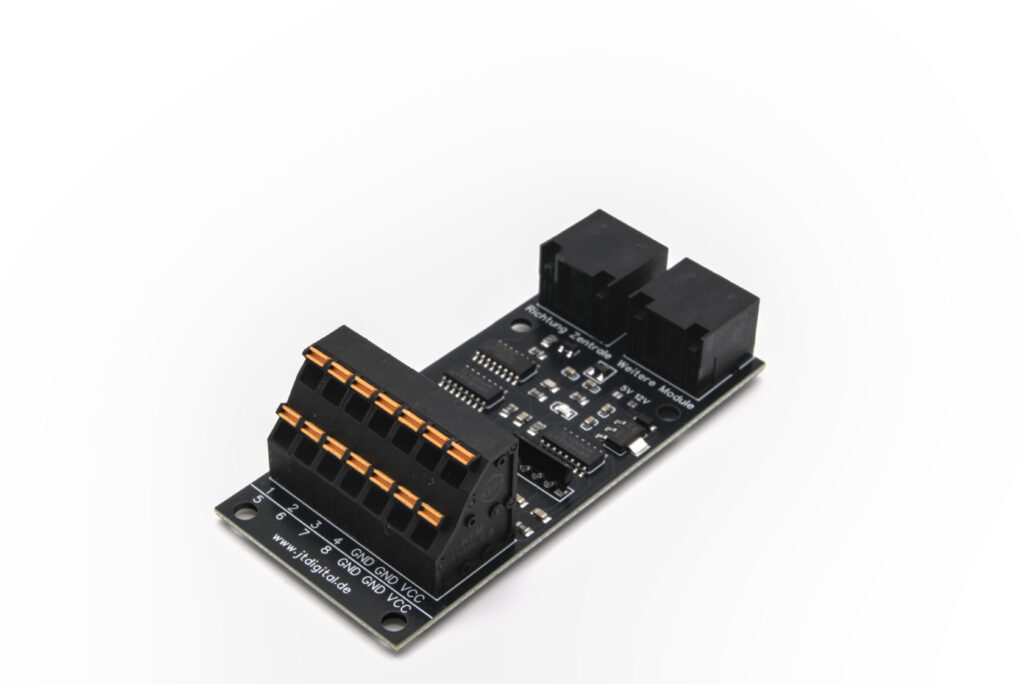
As soon as a vehicle draws current in the monitored track section, the signal output (DATA) of the current sensor switches to ground (GND). You pass this signal on to an input of an s88 or s88-N feedback module, which reports it to the command station or your control software. Alternatively, connect an LED with a suitable series resistor, for example for red illumination in a track diagram control panel.
The current sensor is installed between the track output of the command station or booster and the monitored section. In the 2-rail system you separate one rail for this, in the 3-rail system the centre rail or both outer rails. With the potentiometer you set the sensitivity so that even a single axle of the locomotive triggers the signal. Thanks to spring terminals, the current sensor is wired quickly and without soldering.
What else you need
- an s88-N Feedback Module, if the signal is to reach the command station
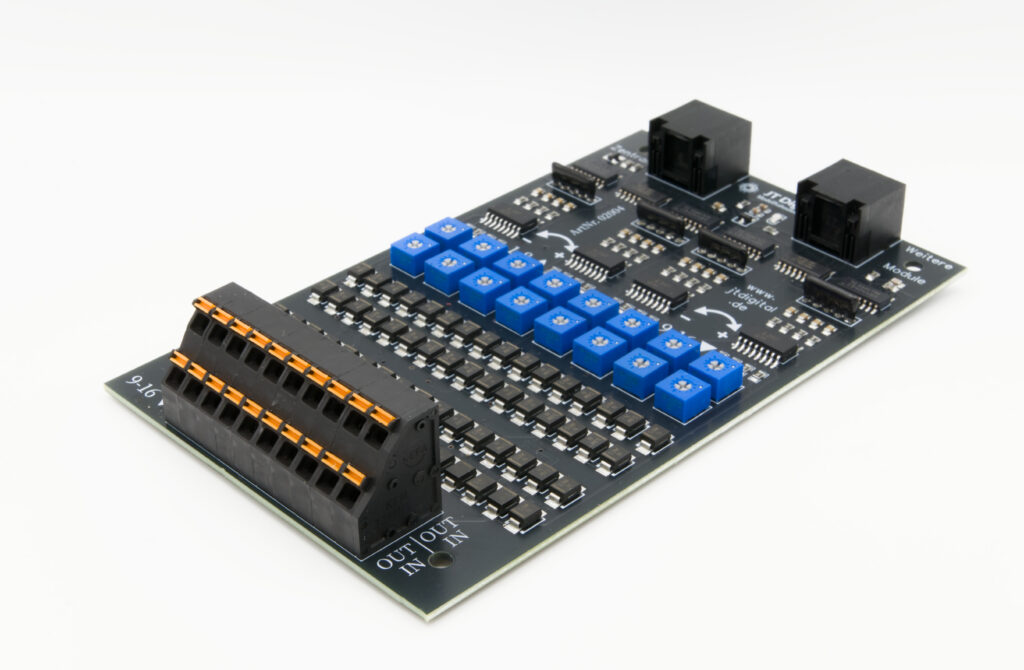
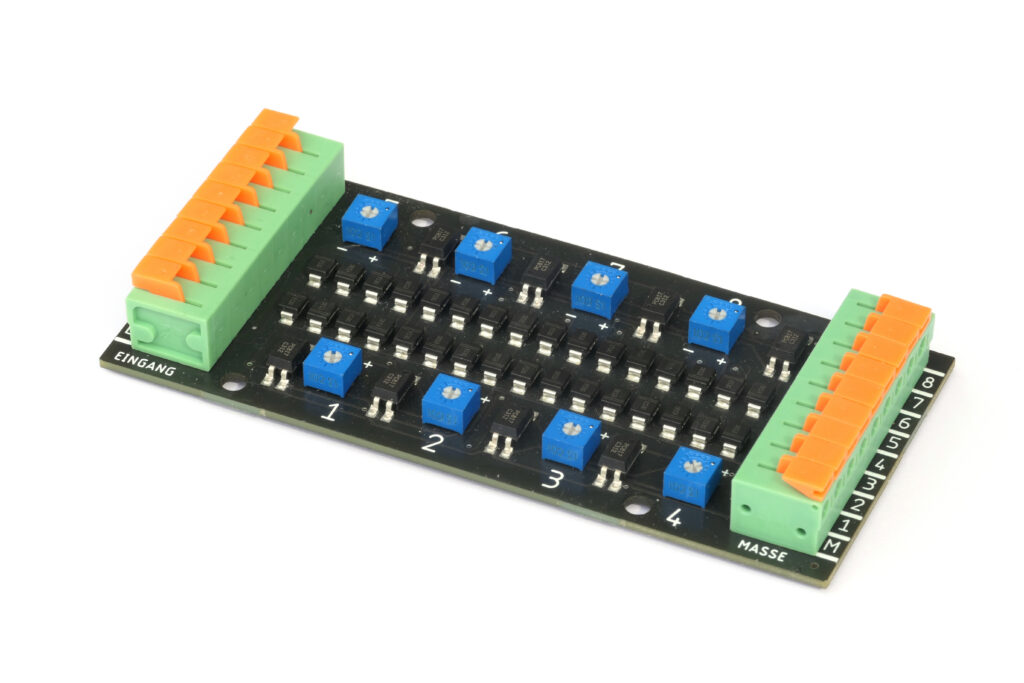
- for several sections: the Current Sensor 8×3A with eight outputs or the s88-N Occupancy Detector, 16-way with built-in feedback module
Note: The current sensor only works on digitally operated layouts; analogue operation is not supported. The command station or booster must supply no more than 3 A and must have active short-circuit detection.
Frequently asked questions
Do I need a separate feedback module as well?
If the signal is to reach your command station: yes, an s88 or s88-N feedback module. For a simple indication with an LED in the control panel, you do not need a feedback module.
Can I read out the occupancy detection with an Arduino?
Yes. The signal output switches to GND. Connect the GND of the current sensor to the GND of the Arduino and DATA to a digital input with an internal pull-up resistor (INPUT_PULLUP). An occupied section is then read as LOW. Important: never connect the GND of the current sensor to the track.
Does the current sensor work with Märklin or in the 3-rail system?
Yes. It is designed for H0 in the 2-rail and 3-rail system as well as for TT, N and Z, and supports DCC, Motorola, mfx and Selectrix.